


It started with a lure and a seven-year-old’s persistence. At home on the kitchen floor, little Micke held the opening with a finger, twisted his hand slightly, and discovered that the tones could be shaped. The hazel grouse’s delicate language was there, in a small metal pipe. That day, the sound became a key. Today, the same game is his life’s work, where he hosts curious travelers from all corners of the earth.
It’s close to zero degrees Celsius at the end of September. The sun lies like a promise behind the horizon. The leaves around the clear-cut in front of us change from summer green to yellow, and among the stumps, young birches shoot up, thin as violin strings. The only thing moving is a slight wind. Far away, a woodpecker pecks, stubbornly and monotonously.
“The heat has delayed most things this year, even the moose rutting season is late, so this is what I’ve been waiting for,” says Mikael Suorra, founder of Hide and see.
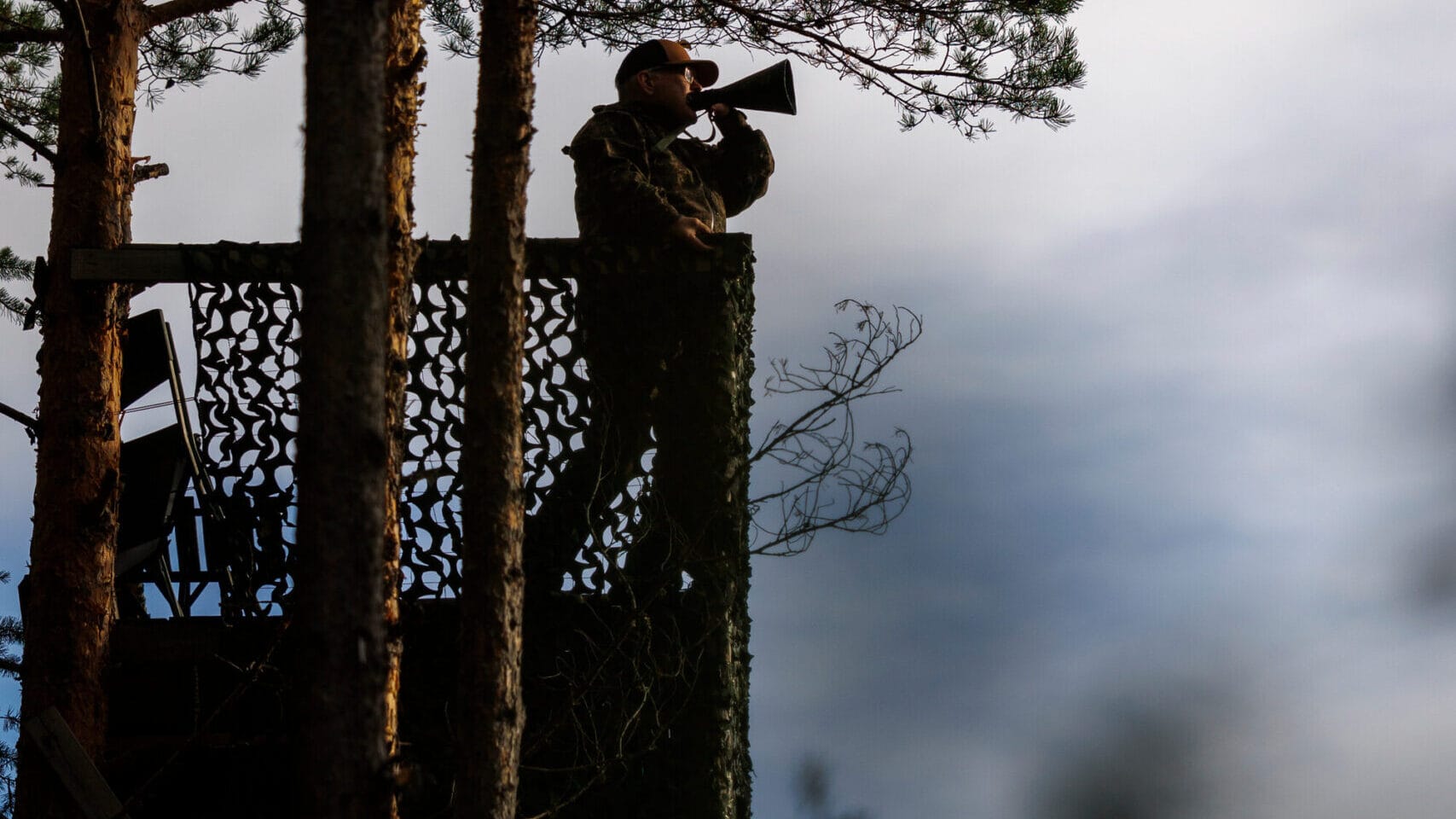
He puts his hands around his camouflage-clad call horn, cobbled together from an old megaphone funnel from the 80s and still a faithful servant. He leans his body slightly back and lets a drawn-out, vibrating whhhhooooaaa roll out over the hills. A siren – but alive. We listen. The forest answers with silence.
We move. At the next spot, his own construction rises – a sturdy moose tower with room for three guests. Around it lie dry twigs that reveal every step, a natural alarm when the guest of honor arrives. Mikael points towards the stream further into the forest and tells of bulls that have come galloping at the water’s edge, of bears that have curiously been drawn to the calf’s sound but turned in the scent of humans, of moose that have fought for attention in sight of his calls. Spectacles that have made international visitors gasp.
This morning there will be no moose for us. Instead, we get a world-class nature experience – and a hospitality to match. It is not difficult to understand why Hide and see has become an obvious name in international agent networks and why Mikael was awarded at the latest business gala.


Calls as Language
In 1984, he started calling moose in earnest. Cassette tapes with Gunnar Sund spun in the tape recorder, but soon the ear took over.
– Moose have a whole vocabulary. Mumbles, whinnies, warnings. If you make the wrong sound, they run. If you make the right one, they turn into the wind and come.
He shows how he can stop a bull that is thinking of going around us – a short, dark sound, almost a barely audible whinny. The stories continue, and he smiles at the memory of a friend’s first moose that he helped to lure out: thumbs up in the tower, then it was set.
But calling is not just hunting. It is interaction.
– The exciting thing is the meeting. To get a wild animal on your terms, feel the contact – without anything needing to be felled.
That insight became the basis for the company, where others can feel the pulse in the forest without firing more than the camera’s shutter.
From Fish Farming to Company
The road here has not been straight. For a decade, Mikael worked as a fish master and coordinator at a fish farm, drove deliveries back and forth and talked about fish conservation in village halls, in projects and by lakes and streams where he planted live fish. An occupational accident overturned the plans – the elbow broke, the rehabilitation was long. Then he began to re-evaluate things.
– What in life gives energy? What can I do? The more I thought, the more I started thinking about doing something with nature. Then I started checking if there were any businesses that offered nature experiences adapted for people with physical disabilities – which there weren’t in the entire Nordic region then. There I saw an opportunity to do something unique.
In 2012, he registered Hide and see. What started with eagle watching in a timbered hideout grew into a palette of experiences: moose calling in autumn colors, northern lights tours and snowshoeing in sparkling winter landscapes, ice fishing where the coffee steams from the cup, hikes through the scent of summer-warm bog and birch. The guests come via high-end destinations in Edeforsbygden, or via international agencies with the whole world in their address book.

Proximity Life as a Business Idea
What drives Hide and see is equal parts passion and principle. Mikael alternates areas to avoid ground wear, early chose the cleanest snowmobile engines and built hides with solar cells to keep silence and technology in balance. He has thought about accessibility – everyone should be able to participate on the same terms as everyone else.
It is Närhetslivet as a method: to live and work where you stand, with care for the place and the people.
Mikael also carries with him his Sami origin. As a child, he spent the summers on the mountain with his family and gained a Sami sustainability mindset – to take care of nature, not take more than you need and live in interaction with the place.
– That attitude has followed me in everything I do. The proximity to nature is not just a backdrop for the business, but a part of the lifestyle – and perhaps the biggest asset in Hide and see.
When he was awarded the sustainability prize at the Business Gala in 2025, he felt extra proud that it was precisely that category.
– One of the criteria already when we started was that we would work sustainably, even with social sustainability. To be inclusive and create participation. Then it means a lot that someone sees the work we have put down in silence for so many years. It was like running a marathon and finally crossing the finish line, he says.
It was not the first time his work was noticed. Previously, Hide and see has, among other things, been awarded the Great Tourism Prize in Norrbotten and named Tourist Company of the Year in Boden.

Small – and Strong
The company is deliberately small-scale. It is only Mikael and his partner Anna, sometimes with the children Emil and Filippa as reinforcement.
– It has gone well for us and I have every opportunity to switch up. But the dream was never to become a supervisor for fifteen employees. The dream was to stand here at dawn, listening for answers.
That freedom also makes room for tailor-made activities: a detour to the Arctic Circle, an evening tour after the northern lights when the forecast promises dance, a slow hike where the forest’s stories are given time.
– Then it becomes more genuine for me too, and the guests notice that. I definitely think that small-scale is one of the strengths in this business – because it becomes just genuine.
The collaboration with destination actors has honed the craft.
– It sits in the small details, says Mikael while adjusting the reindeer skin by the fireplace. It is they who reinforce the memory images and make a difference. I learned that from Britta Jonsson Lindvall who founded Treehotel.
A Siren in the Forest Land
We return to the clear-cut. Dew glitters on the birches’ tender leaves. Mikael takes a breath, shapes his hands and lets yet another powerful whhhhooooaaa go through the valley. It dies out in a long echo, as if the forest itself pulled the blanket tighter around itself. No answer. Just that woodpecker – rhythmic, faithful.
But even if the moose are delayed this time, what makes Hide and see unique still shows itself: the security in the hospitality, the respect for the place and a rare ability to make us listen. Not only for animals – but also for the stories that the place carries.
What once started with a call lure has grown into a life’s work on nature’s terms. Today, Mikael receives guests – a well-trained stone’s throw from home in Nedre Svartlå – and yet with the world as an audience.
TEXT: André Samuelsson